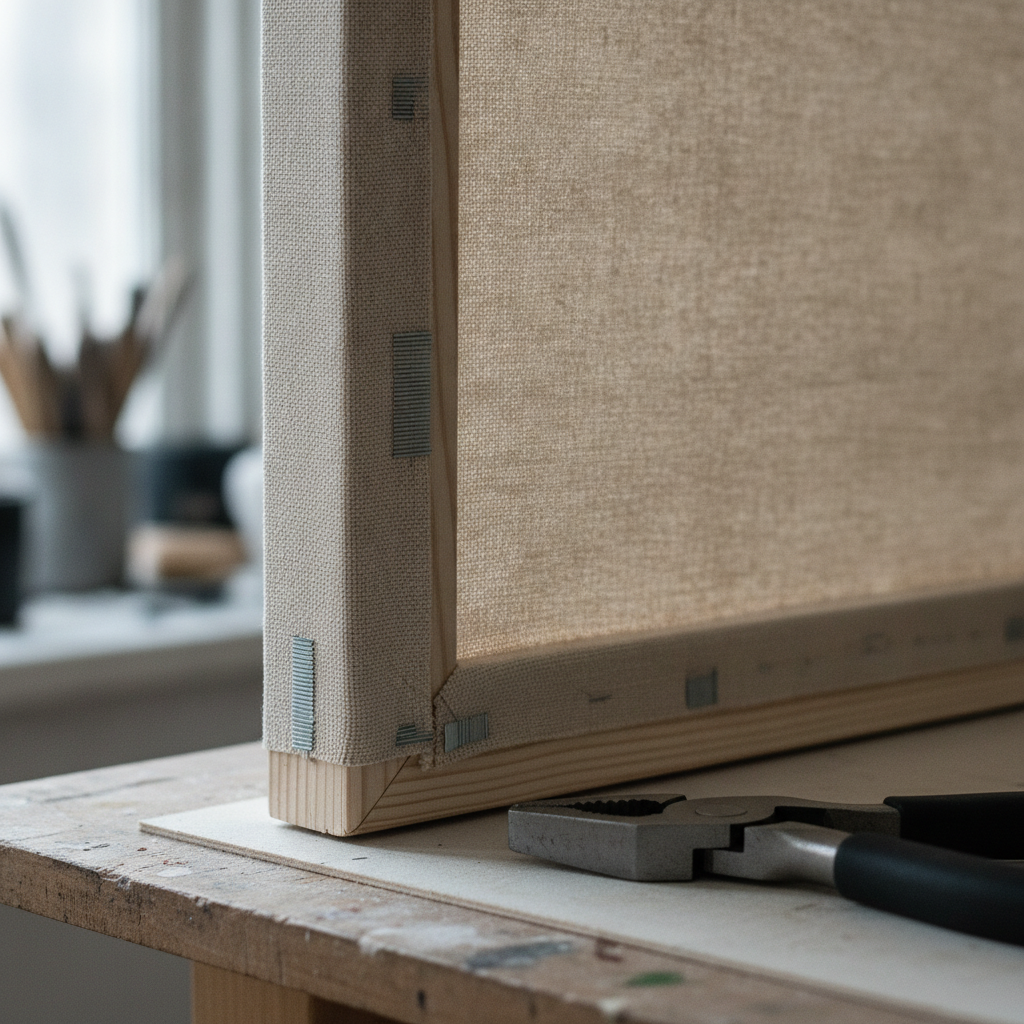
A badly stretched canvas pulls its own stretcher bars out of square. The fault is almost always the order the staples went in rather than how hard the canvas was pulled.
Work from the centre out
Start with one staple at the centre of one bar. Move to the opposite bar, pull moderately, staple. Then the two remaining centres, again opposite each other. Only once all four centres are fixed do you work outwards, always alternating sides.
Going along one bar and then the next drags the frame diagonally. That is what produces a stretcher that rocks on a flat surface, and no amount of later tightening corrects it.
Tension
The canvas should be taut, not drum tight. Over-tensioning bows the long bars inwards and puts permanent stress on the corners. A gentle push in the middle should give slightly.
Raw canvas tightens as it is sized and primed, so it needs less tension at the stapling stage than feels right. Pre-primed canvas moves much less and can be pulled a little firmer.
Corners
Fold one side flat against the bar, then bring the other over it to make a clean diagonal. Staple through both layers. Keep every corner folded the same way so the frame is loaded evenly and the finished sides look consistent.
Afterwards
Check the frame is square by measuring both diagonals; they should match. If they do not, remove the staples along one bar and redo it, rather than trying to force the frame back with clamps.
Canvas responds to humidity, so a slightly slack canvas in a damp month may tighten on its own. Corner keys exist for exactly this and should be tapped in a fraction at a time, checking the diagonals as you go.
Leave a Reply