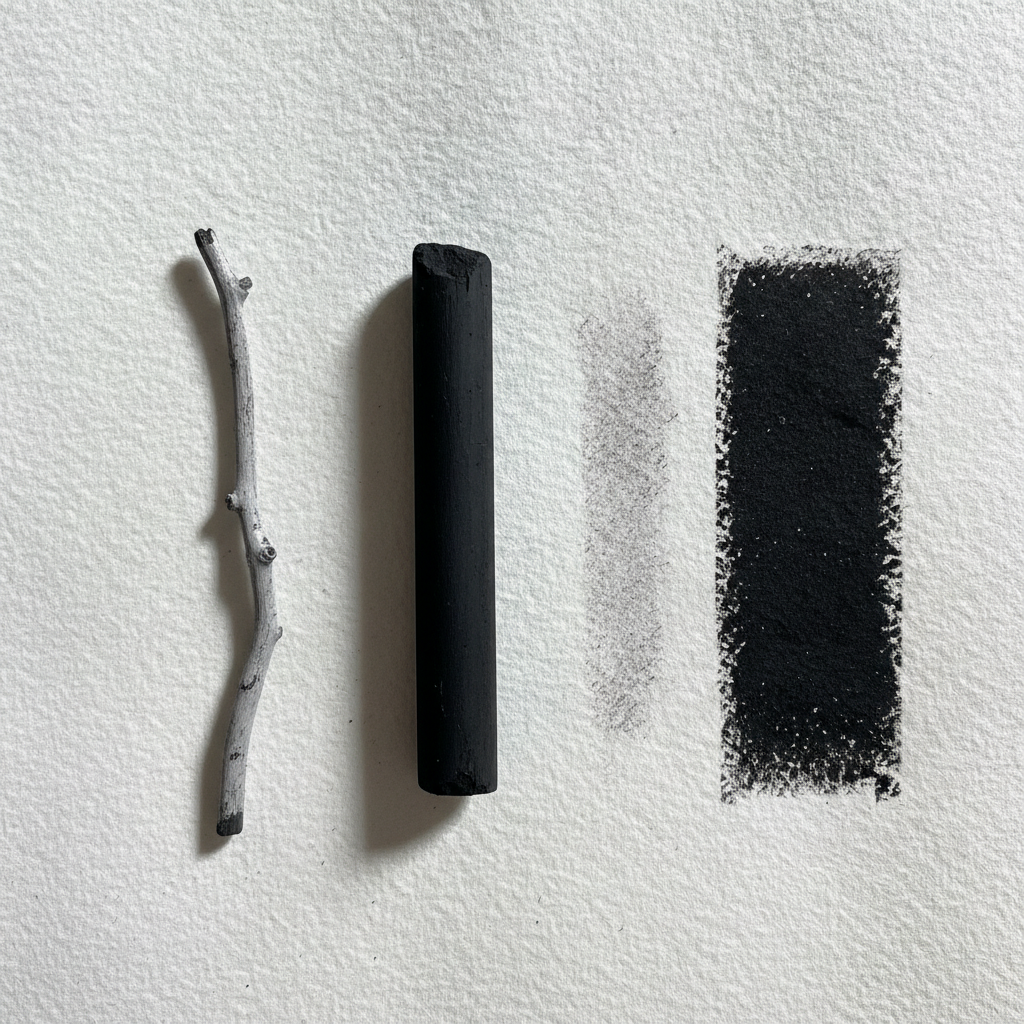
The two look similar in the box and behave like different media. Choosing the wrong one for the stage of a drawing accounts for a great deal of unnecessary frustration.
Vine and willow
Burnt twigs, essentially: light, dusty and barely attached to the paper. They lift almost completely with a cloth, which makes them ideal for the searching stage of a drawing where everything is provisional.
The limitation is depth. Vine will not give a true black. Pushed hard it silvers and skids rather than darkening.
Compressed
Powdered charcoal held together with a binder. It is dense, goes very dark, and grips the paper. That makes it right for finishing, for the darkest accents and for anything that must survive handling.
It is also close to permanent. Compressed charcoal in the wrong place will not fully erase, and the ghost stays visible in the finished drawing.
Using them together
The standard sequence is vine for construction, then compressed once the drawing is settled. Working the other way round means committing before you know where anything goes.
A kneaded eraser is the natural partner to both. It lifts rather than abrades, so it can pull a highlight out of a dark passage without destroying the tooth of the paper.
Paper and fixing
Both need tooth. On smooth paper charcoal sits on the surface and smears at the first contact.
Fixative darkens the drawing slightly and reduces the very lightest marks, so it is worth allowing for that before spraying. Light passes from a distance, several of them, beat one heavy pass that floods the surface and pools in the darks.
Leave a Reply