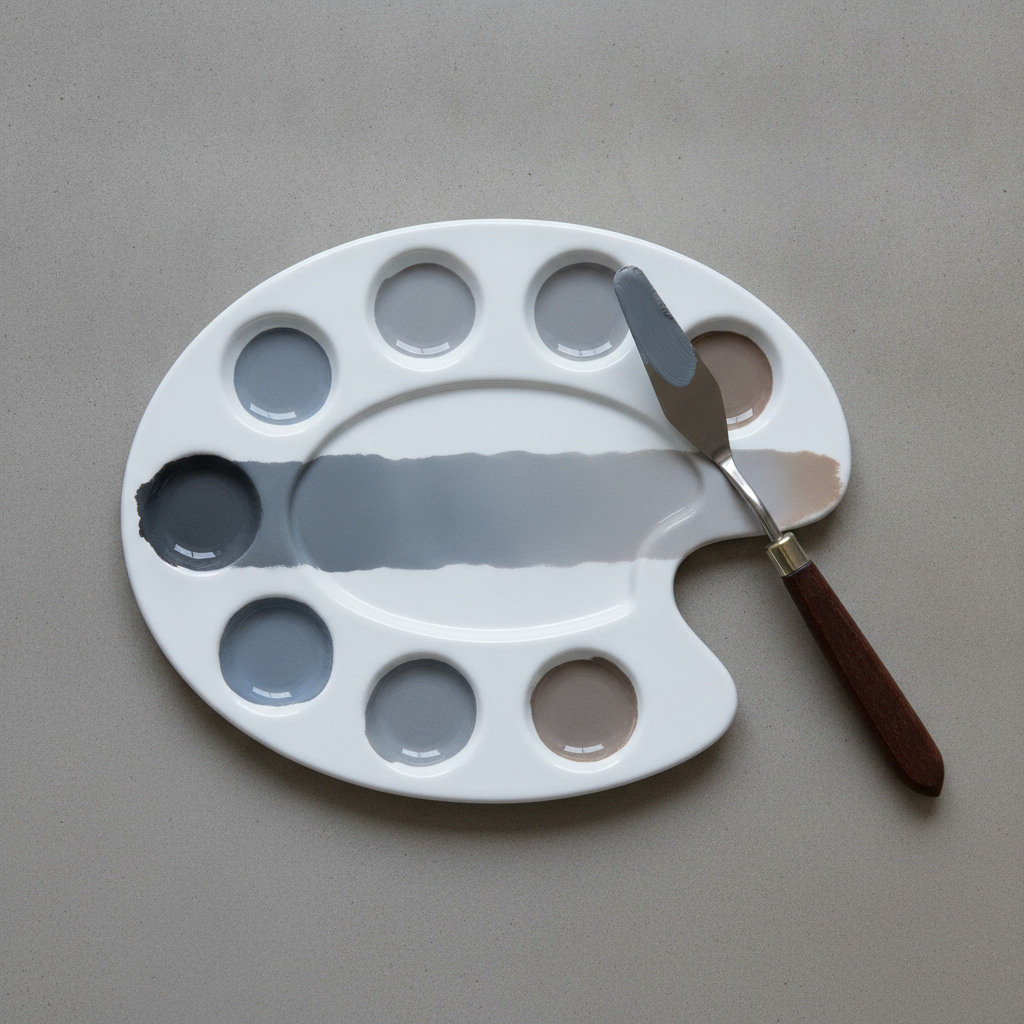
Tube greys are convenient and nearly always flat. A mixed grey carries a hint of the colours that made it, which is what lets it sit believably next to everything else in a painting.
Complements first
The standard route is to mix a colour with its opposite. Blue with orange, red with green, yellow with purple. As the mixture approaches equal strength the colour drains out and you are left with a grey that still leans slightly one way.
That lean is the useful part. A grey mixed from ultramarine and burnt sienna leans cool or warm depending on the ratio, and can be pushed either way in the middle of a passage without changing pigments.
The reliable pair
Ultramarine and burnt sienna is the workhorse. Both are widely available, both are reasonably transparent, and between them they cover almost every grey needed for shadow. Add water for a pale atmospheric grey, use it thick for something close to black.
Phthalo blue with burnt umber gives a colder, harder grey with more staining power. Useful, but phthalo takes over quickly, so add it to the umber rather than the other way round.
Why mixtures go muddy
Mud is usually three or more pigments fighting, particularly when one is opaque and heavily filled. Two pigments plus water almost never goes muddy. Three sometimes does. Four nearly always does.
The other cause is disturbing a layer that has not dried, lifting the pigment underneath into the one above. That is a timing problem rather than a colour problem, and no amount of remixing will fix it.
Testing properly
Mix a strip that runs from one parent colour through neutral to the other, on the paper you actually use, and keep it. Greys look completely different on cream stock than on bright white, and a swatch made on scrap tells you very little about the finished piece.
Leave a Reply