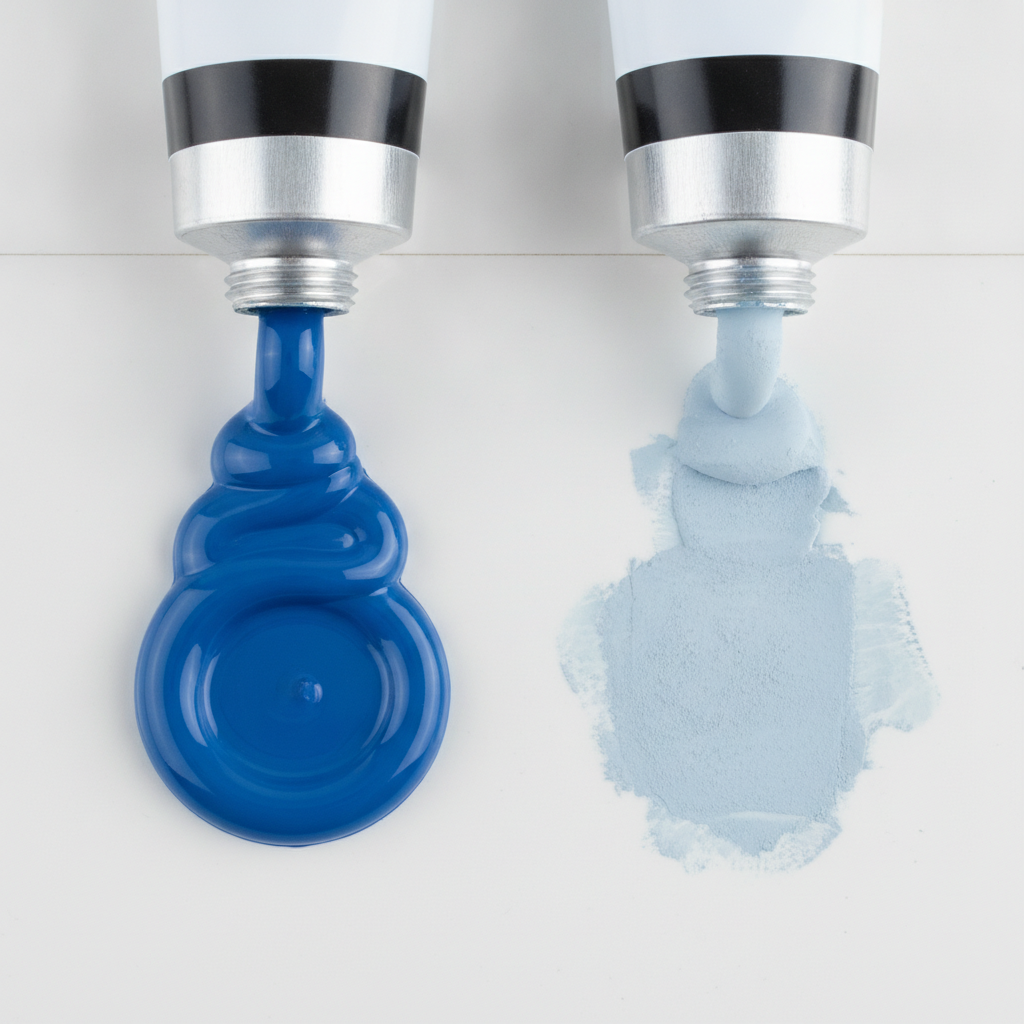
The gap between the two ranges is real, but it is not a matter of one being good and the other bad. It comes down to how much actual pigment is in the tube.
Pigment load
Artist-grade paint carries more pigment and less filler. That shows up in three ways: colours reach full strength with less paint, mixtures stay clean rather than turning chalky, and a thin layer still covers.
Student ranges bulk the paint out with extenders. The colour is still the colour, there is simply less of it per squeeze, which is why it can look weak and why mixtures drift towards grey.
Hues and substitutions
A colour labelled “hue” is an imitation of an expensive or discontinued pigment, mixed from cheaper ones. Some are excellent. The catch is that a hue mixes according to what is actually in it, so a cadmium red hue built from a bright organic red will behave nothing like real cadmium in a mixture.
Check the pigment index on the tube, the PR, PB, PY codes. Two tubes with the same code from different makers will behave similarly. Two tubes with the same marketing name and different codes will not.
Where to spend
The sensible compromise is artist grade for the colours doing the heavy lifting, usually the two or three you reach for constantly, and student grade for everything else and for practice.
White is worth buying properly whatever else you economise on, because it appears in a huge proportion of mixtures and a chalky white contaminates all of them.
Consistency over time
Student ranges are reformulated more often and discontinued more readily. If you are working on something long-running where colours must match across months, that alone is an argument for the artist range.
Leave a Reply