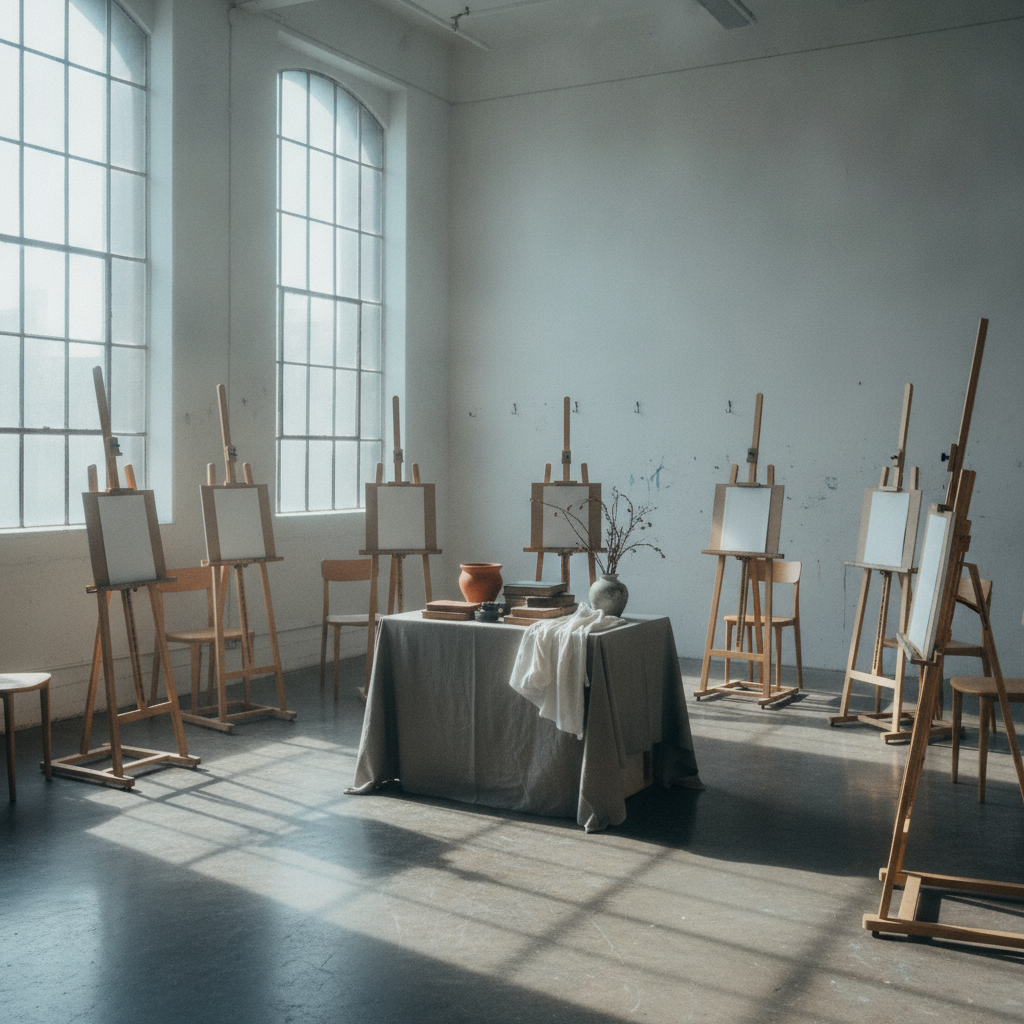
Notes on learning in a group, choosing a class that suits how you actually work, and getting something out of a workshop beyond a single finished piece.
What a good class gives you
Time set aside, a room where materials are already out, and someone watching your hands who can tell you that the problem is your brush angle rather than your paint. That last part is difficult to get from a book or a video, and it is the main argument for learning in person.
Choosing between formats
A short single-session workshop suits a specific technique: a printmaking method, a particular kind of wash, stretching and preparing a surface. A longer course over several weeks suits anything that needs work between sessions, such as drawing from observation or building up a painting in layers.
Series aimed at one medium tend to be more useful than general classes once you have a little experience, because the tutor can assume some shared ground and skip the introduction.
Getting more from a session
Take the materials you normally use rather than buying a new set for the day. Half the value is finding out what your own kit does under supervision. Bring an unfinished piece that has gone wrong, if the format allows it, and ask about that specifically.
Write down what happened afterwards, the same evening if possible. Technique fades quickly and the notes are usually more valuable than the piece produced on the day.
Learning alone
If classes are not practical, structured self-teaching works, but it needs an outside reference point. Repeating an exercise and comparing it against a known result is slow and unglamorous and it does work.